Figuring out what to focus on now & what to focus on next in science and higher ed
This newsletter is my part of an ongoing conversation among colleagues who’ve had a rough week. I share two or three pieces of the puzzle that feel are most important, hazard a guess about what to expect next, and offer at least one useful thing to do.
MEETING THE MOMENT: 2025-02-28
Hello friends,
Grab a glass, grab a snack, get comfortable. It’s the end of another hard week, at the end of a short and dark month. I’m glad you’re here thinking about it with me. This was week 6.
As always, we face two core questions: what is happening? And what should we do about it? I hit a bit of a low this week when one too many people told me it was impossible to do the former along their way to demanding satisfying answers to the latter.
Here’s the thing: it’s difficult to track all the things that are happening, yes. It takes a lot of digging, constant attention, and a willingness to do the math and connect the dots to produce a coherent big-picture understanding from all the fragments and details. And I can’t do it alone: I depend on countless journalists, connections, and collaborators to find and share the facts. But it is absolutely possible to keep track of it all. And it’s not just that we can do this, it’s that we must do it.
We need to build a durable understanding of our situation and use it as a springboard into action. Our commitment to stay focused and not flooded is both why and how we do this work. I have a lot more to say about doing it well. But first, let’s dig in to some specifics:
What’s happening now:
- Our trans colleagues and community members are navigating dystopian conditions. Since the beginning of the year, more than 450 new anti-LGBTQ+ measures have been introduced in state legislatures. Yesterday, for example, Iowa lawmakers decided to strip civil rights protections for trans people out of their legal code. On Wednesday, legal proceedings made the Pentagon’s memo to disqualify and discharge transgender servicemembers public. The same day, a bill was filed in Texas to ban all gender-affirming care for everyone. Meanwhile, changes to passports and visas are making border crossings more dangerous for those who are even able to still travel internationally. While multiple lawsuits are underway, guidelines for conducting safer fieldwork are more important than ever.
- Other physical harms continue. I first flagged measles as a specific worry two weeks ago. It is one of the most contagious diseases there is. Yesterday, the CDC count reported 164 cases in nine states. Reporting lags mean this is an undercount, but something like 90% of those cases are linked to an outbreak in Texas. It killed a little kid this week. It’s been more than 20 years since a child died of measles in the United States: this death, and all the hospitalizations, are in fact, very unusual. We can hope that it stays that way, but our “measles: eliminated” status is more fragile than it might seem. In a large majority of states, vaccination rates among kindergarteners are well below the 95% threshold necessary to prevent outbreaks. The WHO calculates that measles vaccinations prevented more than 60 million deaths between 2000 and 2023. Yesterday, CDC researchers were forbidden to co-author papers with colleagues at WHO.
- Meanwhile, the administration has terminated funding for polio, HIV, and malaria programs as it continues to destroy USAID. This week, former agency staffers had just fifteen minutes to retrieve belongings from offices they’d been locked out of: some still don’t even know their current employment status. That’s not true for approximately 800 NOAA employees who were terminated yesterday and today, with only hours notice, including some whose supervisors were not notified in advance. In all these cases, it’s important to understand who, exactly, is ordering the firings and on what grounds. On the upside, a handful of people had their jobs at NSF reinstated today, six more won their appeals, and a federal judge ruled today that many more federal firings were likely illegal. Unfortunately, the body that handles employment appeals, the Merit Systems Review Board, is flooded with a ten-fold increase in cases in addition to being very precarious right now. In a similar vein, despite multiple orders from multiple judges and the advice of their own lawyers, NIH funding remains catastrophically frozen. Across the board, in all the areas we care about, we’re facing more terminations of grants, reductions in training programs and graduate admissions, as well as further mass layoffs and budget cuts in the coming weeks.
What’s next:
The Stand up for Science events are all happening next Friday. Next week will also likely include a lot of focus on economic worries and big federal budget fights. With everything I just listed, plus tariffs against Canada and Mexico slated to kick in next Tuesday, and more threatened against Europe, it feels grim.
What to do:
Let’s start with what NOT to do. Do not give up. Do not convince yourself that nothing will make any difference. And definitely do not tell people who are taking action that their efforts don’t matter.
I wrote earlier this week that we exist in a situation where several things are all simultaneously true:
- We may have reasonably good grounds for predictions about what will not work, but we cannot confidently predict what will be effective
- It is wildly implausible to imagine that any one thing is going to be THE THING that makes all the difference
- We need to have a serious talk about what we mean when we discuss “what works” and “what matters.”
On that last point, I want to talk about a diagram that I’ve found helpful for many years. This is an impact effort matrix (sometimes also called impact mapping). Some of you have seen me teach it. It’s a great tool to think with, despite three key challenges. First, we don’t know how to actually assess impact, and we tend to overestimate it. Second, communications and movement work are full of the kind of emotional and invisible labor that academics consistently underestimate, so we botch that axis too. But worst of all, and even once we correct for those first two issues, we consistently make the critical error of assuming only the high-impact work matters.
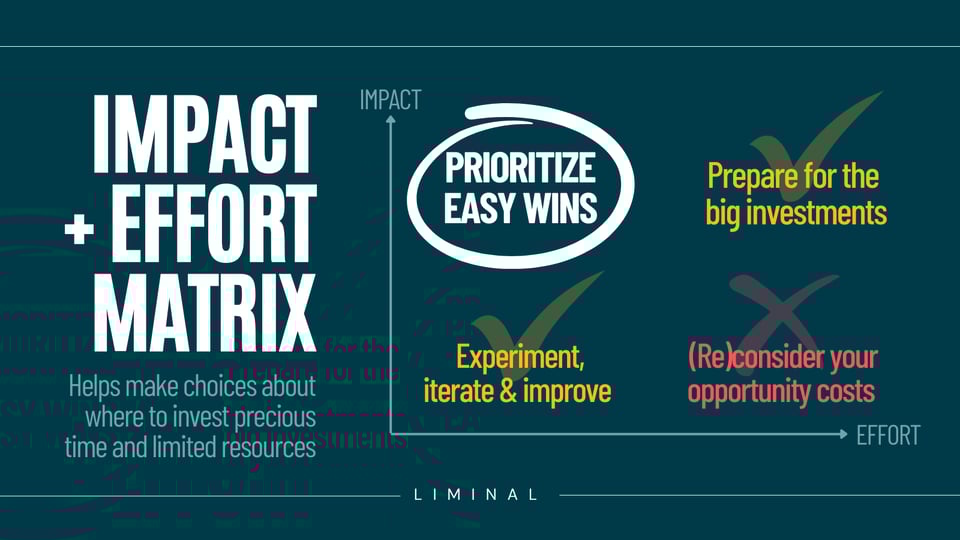
In fact, low effort, low impact work might just be the hack we need right now. There are all kinds of potentially positive outcomes from low-effort work: overcoming inertia and anxiety, honing skills in lower-stakes settings, finding other like-minded collaborators, building up buzz and perceived social salience, and so much more.
And look, I’m not saying we shouldn’t be constructively critical! It’s hard for me to get excited about anything that doesn’t have a plausible theory of change, for example. I also worry about our limited resources and rapidly-closing windows of opportunity. But I also recognize that we all have different action logics, and I know that when people are working right at the edge of their capacity, morale is incredibly important. We don’t have to support everything, but I hope we can resist the instinct to rip each other’s ideas to shreds. For good thinking about how to get people new to a practice started off on good footing, I’m massively inspired by the data science concept of “good enough” practices.
So I’ll end by sharing a few things that feel meaningful to me. I loved that supporters gathered outside the USAID office to applaud the departing workers. Their presence was a protest, but one that was about bearing witness and gratitude too. I similarly appreciate the National Park rangers who are documenting every firing, and telling the stories of how this hurts our parks and our people.
I think “what should we do” must include mutual aid and care for victims, in addition to efforts to avert the harm. My own head and heart are racing alongside everyone building trackers and new tools, like Action Lab. My appreciation is with the many hands doing all the data wrangling we depend on. I’m grateful for the people screaming in the streets and I’m grateful for the ones quietly but relentlessly fighting in closed door meetings.
We need it all. We need you. Thank you for everything you do. Keep going.
Liz