July 28-Aug 1, 2025 - failing down the garden path
Hello friends,
I found out yesterday that I didn’t get a fellowship that I really wanted. The instinct to immediately downplay that is strong (so strong!) but I think it’s a priority to talk about disappointment and loss right now. I’m the kind of person who still burns with shame about anything I do that isn’t a success. Not everybody is built like this (thankfully!) and I’m vastly better than I was before. How do you judge yourself? Are there patterns in the explanations or justifications you reach for?
What are the coping mechanisms you’ve developed? What do you say to the people you care about when they experience rejection or failure? Were you even willing to spend time with these questions? And the hardest question: how might our habits around failure need to change in the months ahead?
This is a MUCH bigger question and entirely separate from the small failure I’m sitting with today. I’m raising it because I believe that the job markets, funding prospects, and other forces shaping science in this country are on the cusp of creating losses at a scale and intensity we are profoundly unprepared to manage.
This was Week 28 and that was a bold claim I just made about the future. Let’s unpack it together.
What’s happening now
- Yesterday, UCLA became the latest university to have its research funding frozen by the administration. Hundreds of NIH and NSF grants worth an estimated $300 million are affected, and researchers have been told to immediately halt their expenditures. The action is framed by the administration as fighting anti-semitism, as many of its attacks on universities are. It came one day after UCLA reached a controversial $6 million settlement over on-campus protests - the same day that Brown agreed to pay $50 million to get its research funding reinstated. After Columbia’s deal I wrote about last week, I’ve been closely watching for any concrete news from Harvard (“considering a $500 million deal” “as a starting point”) and Cornell (“close to a $100 million deal”). I do think there are important details to parse in the deals (e.g. Brown is investing that money in Rhode Island workforce development grants, rather than paying the administration), I recognize that restored funding does seems to be going out, and I do understand the economic argument in favor of settling for millions when billions of dollars are at stake: I admit that I simply find these capitulations to be morally repugnant. I also think that while restored funding is definitely something to fight for and celebrate, even these wins carry stark realities with them, including the very real prospect of Supreme Court intervention on the administration’s behalf. Right now, more than one hundred other universities are under investigation. At this point, I think the playbook is obvious and the likely path forward is grim.
- Part of what inspired this issue’s theme is today’s news about the July jobs report. In brief, the Bureau of Labor Statistics (BLS) releases employment figures each month, and while revisions to past months are a normal, good practice, today’s adjustments were a shock. For both May and June, estimated job gains were revised downward by more than 100,000 each. Put another way, the government had overestimated gains by a total of 258,000 jobs. The stock market dropped in response to the “eye-opening bad” numbers, likely not helped by other worrisome economic indicators. And while all this was unfolding this afternoon, the president disparaged and publicly fired the head of the head of the BLS, Dr. Erika McEntarfer. This all further exacerbates experts’ deep fears about the quality of U.S. economic data.
- Finally, I just want to mark this sad moment. After the rescissions package clawed back $1.1 billion dollars in previously-approved funding, the Corporation for Public Broadcasting officially announced today that it is shutting down.
What’s next & what to do
The final piece I wanted to share today is a note of gratitude to the folks at FAS and ASTC who have helped educate me on impoundments, pocket rescissions, and other budget maneuvers, as well as the myriad types of interference in grantmaking (← if you only click one link in this issue, make it this one). It’s been so helpful, if difficult, to work toward a robust understanding of how the entire system is changing right now.
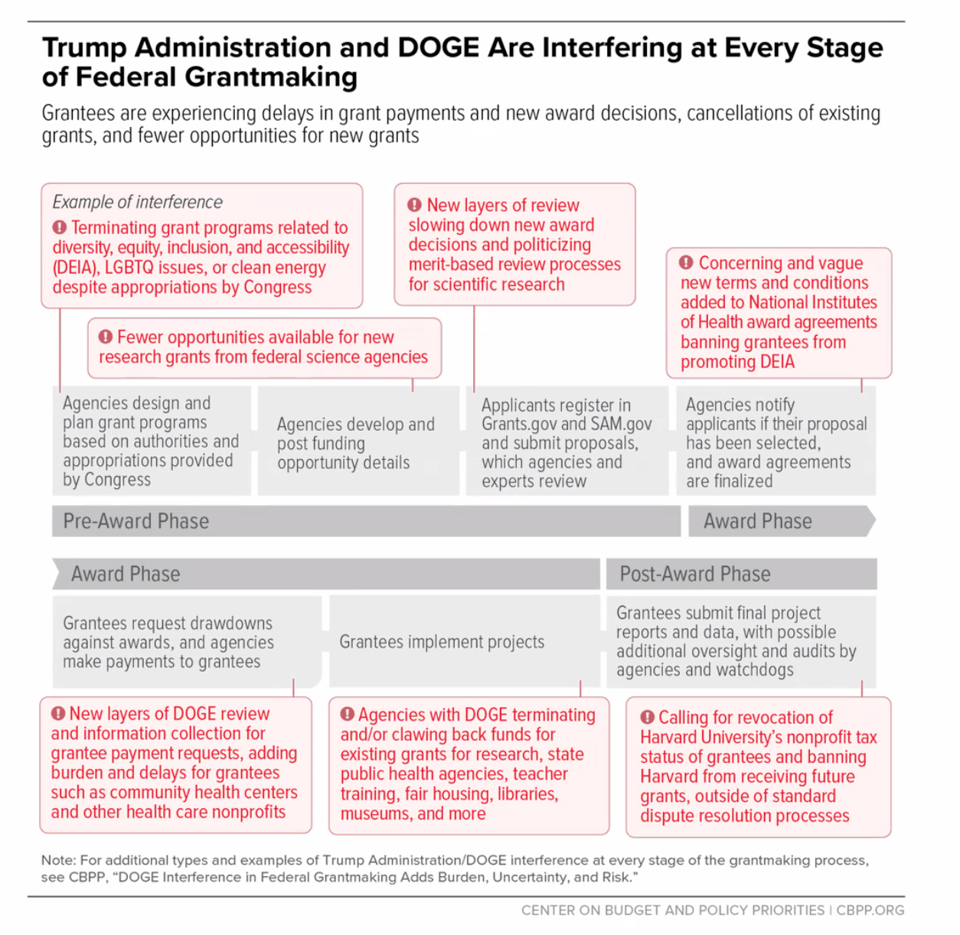
At a high level, I think that science advocates must now wade into procedural fights, even though protecting the integrity of bureaucratic systems demands increasingly specialized knowledge even as it spreads our attention ever thinner. I’m writing this newsletter every week, on top of updating pages with the amazing Unbreaking team. Honestly, I’m a little sick of having to know about and explain things like attempted fiat via footnote (and not just the one that was issued and reversed on Tuesday).
But more specifically, as I build my own understanding of the ways that funding commitments are being terminated, frozen, clawed-back, and otherwise altered, I can’t force myself to really think of them as commitments anymore - it feels more responsible to call them prospects. This kind of uncertainty gnaws at me, and I imagine, most of us who are responsible for keeping the lights on at our organizations.
How do we even know what success and failure actually look like in a funding landscape like this? Is “put your head down and just apply for more grants/fellowships/programs/jobs” honestly the best advice we can give right now? How do we make decisions about what’s worth doing when our whole mental model needs to be adjusted?
Our systems have been grinding people into the dust for decades. They were and have been broken: it is now getting substantially worse. We can’t just “keep at it” - we need to face this failure together.
I keep going back to a recent post I loved by Dominique Baker, “We must see that our lives, our struggles and successes, are bound up in each other. What does collective action look like if you stop being optimistic your [specific market] will improve and instead think about academia as a whole?”
I think it means a whole lot of experiments. Thankfully we’re good at those. But again, we’re back to the idea that a whole lot of the work will likely fail. So those of us who have the best relationships with failure? Get in here, we need you. Those of us who metabolize rejection into spectacularly stubborn motivation? Share some tips please. (And everybody who needs to start a garden, I’ve got just the song for us.)
We need to grow new things. Let’s get our hands dirty.
Liz