What now & what’s next in science and higher ed
This newsletter is my part of an ongoing conversation among colleagues who’ve had a rough week. I share two or three pieces of the puzzle that feel the most important, hazard a guess about what to expect next, and offer at least one useful thing to do.
MEETING THE MOMENT: 2025-05-23
Hello friends,
This is a special edition of Meeting the Moment. It marks four full months of these weekly updates and begins the Memorial Day weekend. It makes sense to me to pause for a moment and reflect.
When I was little, I lived in Germany. My parents decided not to take us to the death camps, but I have a faint memory of the caves where people from our village took shelter during firebombing raids. I remember seeing a WWII motorcycle wrapped around a tree deep in the woods. And I’ll never forget the hours my Girl Scout troop spent helping to place flags on every single one of the 10,000+ graves at the American Cemetery in Alsace-Lorraine.
It was hot and sunny that day, the headstones gleaming painfully white. I would kneel down at the grave of a specific and singular person, and then look up and across the thousands upon thousands more in front of me. I could feel the sweep and weight of history in that strange toggling of sorrow and horror. I understood that I was only seeing a tiny fraction of the cost of that war. And even as a little kid who wouldn’t use these words, I understood something about bearing witness, about how commemoration requires work.
The way that moments become memories, which we imbue with meaning, is core to my work. I think this glimpse into my Memorial Day history explains why I’ve been so committed to explaining the damage the Trump administration and its enablers have done to science and higher ed.
What’s happening now
I am motivated to write this newsletter by defiance. I flatly reject the notion that it is impossible to track what they are doing. Exhausting? Yes. And painful. But we can do it and we must. And not because cataloging disasters is the same as averting them, but because we need to assemble the data so that we understand, react, and one day, rebuild.
As I wrote last week, I think this summer is going to be brutal. The support structures of science are crumbling, and we’re collectively going to feel the consequences in even more visceral ways. And here’s the thing: it’s not just science. Our struggles are part of a much bigger picture.
What’s next & what to do
Week after week, I’ve been encouraging you to get clear about your purpose, build new skills, and make new connections and build community. And it isn’t just talk: I have been busily putting that advice into practice myself, as part of a tremendous new project called Unbreaking.
Unbreaking is a mutual aid project - ordinary people coming together to help ordinary people cope with the crisis of our information landscapes. We believe that mapping the damage to our institutions and its human costs is necessary groundwork for building and retaining political agency. We’re building a set of pages that will convey essential context, document what’s happened so far, and explain how people are trying to preserve necessary services, protect their neighbors and communities, and build systems for collective survival.
After reading Meeting the Moment for weeks, the parts where we summarize what’s happening is going to feel very familiar to you. I think Unbreaking improves on my work here by focusing on the patterns emerging from that chaos. Our specialty is turning a maelstrom of headlines into coherent explanations about how, exactly, people are being harmed and how they’re banding together. And it’s live now! Three issue pages are live now, and many more will follow.
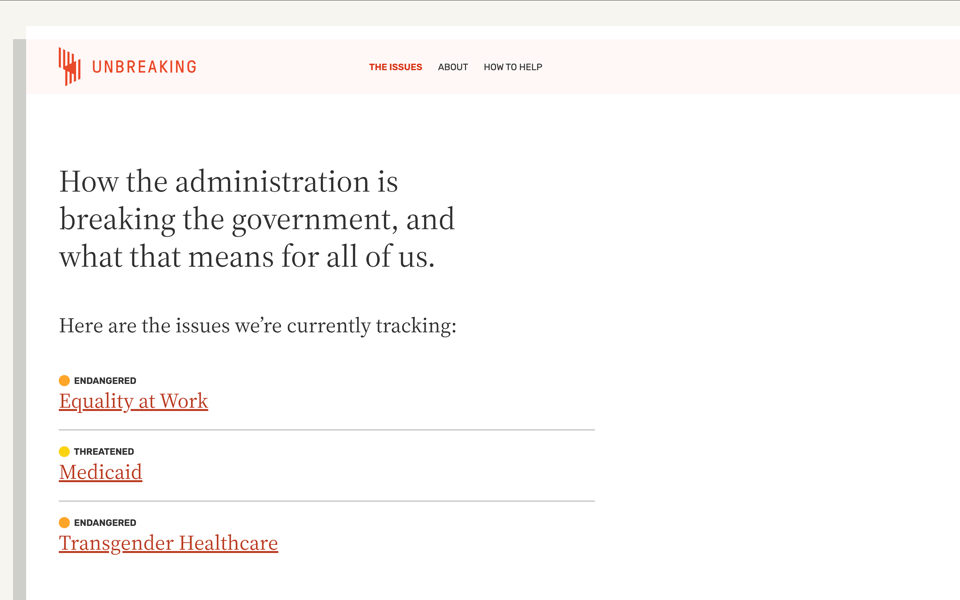
I’m so glad to be doing our work in public, and now I want you to come join us in doing it. We need your skills as researchers, issue experts, sensemakers, and writers. Whatever time and talents you have, whatever resources you can offer, we will put them to good use. When I finish writing this post, I’m going to go finish a draft of our page on funding for medical research. Expect that to be published on May 30, but then remember, we will need to update it every three days or so for the foreseeable future. And what about all the research that’s not medical? And everything that’s not research? Yes, it’s all on our minds. Come help us do it.
As I wrote earlier this week, “Join us because we need you. Join us because throwing yourself into meaningful work helps heal a broken heart.” If the only way out is through, the only way through is together.
Always,
Liz